
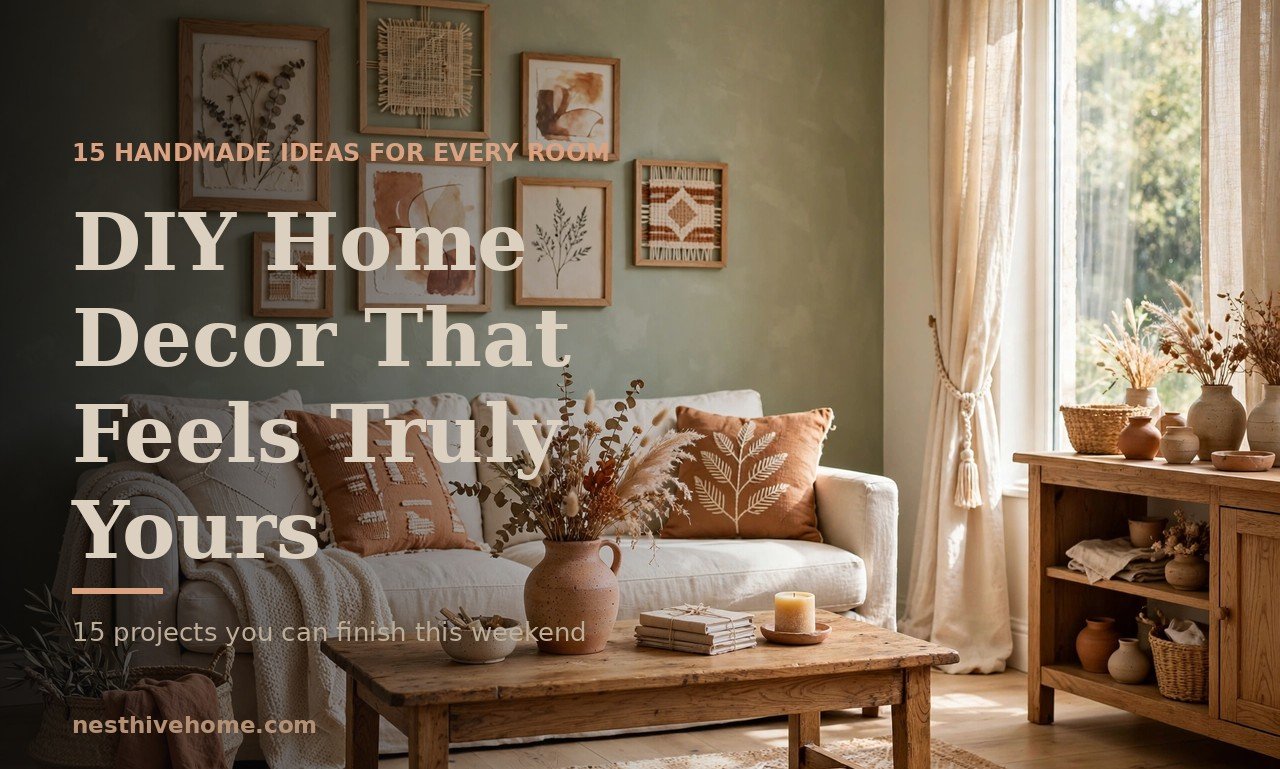
diy home decor is the simplest way to make a house feel like it belongs to you. Instead of buying a room straight out of a catalogue, you shape it yourself: a painted dresser in exactly the shade you love, a gallery wall of prints you chose one by one, cushions sewn from fabric that caught your eye. The result is rarely perfect, and that is precisely the point. Handmade rooms carry warmth, personality, and small stories that mass-produced styling cannot copy.
This guide brings together 15 practical diy home decor projects that suit real homes and real budgets. Every idea below can be finished in a weekend or less, uses tools most households already own, and works in both rented flats and family houses. You will find painted furniture, wall ideas, soft furnishings, lighting tricks, and a clear budget plan, plus the mistakes that catch beginners out.
Why DIY Home Decor Works So Well
Shop-bought decor is designed to please everyone, which means it rarely delights anyone in particular. When you make something yourself, you control the colour, the size, and the finish. A shelf cut to fit an awkward alcove beats a standard shelf every time. A cushion cover sewn from a favourite remnant beats a generic one from a discount bin. That control is the heart of good diy home decor.
There is also a money argument. A solid wooden dresser from a second-hand shop can cost less than a flat-pack equivalent and, with a coat of paint and new knobs, look far more expensive. Fabric remnants, sample paint pots, and reclaimed timber keep costs low while the finished quality stays high. Most of the projects in this guide cost between $15 and $80, and several cost nothing at all if you already have the materials at home.
Finally, handmade pieces age better emotionally, which is why diy home decor holds its appeal long after a project is finished. You remember painting that chair on a rainy Saturday, or framing the pressed flowers from your garden. Rooms built slowly, piece by piece, feel settled in a way that a single shopping spree never achieves.
Start Small: Five Weekend Projects Anyone Can Finish
If you are new to diy home decor, begin with projects that forgive mistakes. Paint, fabric, and paper are all forgiving materials: a bad brush stroke sands away, a crooked seam unpicks, a torn print reprints. Pick one diy home decor project, finish it properly, and let the confidence carry you to the next.
1. Paint a single accent wall
One painted wall changes a whole room for the price of a single tin of paint. Choose a warm sage green, a soft terracotta, or a deep navy, and paint the wall behind the sofa or bed. Keep the other walls light so the colour reads as a deliberate feature rather than a dark box. Two coats, a good roller, and painter’s tape along the edges are all you need.
2. Frame what you already own
Botanical prints from old books, children’s drawings, fabric offcuts, and holiday postcards all look surprisingly polished in matching frames. Group three to five frames together and hang them at eye level, about 57 inches from the floor to the centre of the arrangement. Uniform frames unify mixed artwork instantly.
3. Swap your cushion covers
New cushion covers are the fastest room refresh in existence. Sew simple envelope covers from cotton or linen, or buy plain covers and stencil a pattern on them.
4. Style a tray on the coffee table
A wooden tray, a small vase, a candle, and one book turn a cluttered coffee table into a composed vignette. The tray corrals small objects, which is why stylists use them everywhere. Paint or stain a thrifted tray to match your room.
5. Hang a macrame or woven wall hanging
Macrame kits are inexpensive and the knots are easy to learn from a single video tutorial. A finished hanging softens a plain wall and adds texture that paint alone cannot provide. If knotting is not your thing, a simple woven hanging on a wooden dowel gives the same warmth.
Painted and Upcycled Furniture
Painted furniture is where diy home decor saves the most money. Second-hand shops, garage sales, and online marketplaces are full of solid wood pieces with dated finishes. With a little diy home decor know-how, a dresser, a side table, or a set of dining chairs can be transformed in an afternoon.
Start by cleaning the piece thoroughly and sanding lightly with 120-grit paper so the paint grips. For most furniture, a good primer followed by two coats of furniture paint or chalk paint gives a durable finish. Chalk paint needs a wax or lacquer topcoat; standard furniture paint usually does not. Replace the hardware last: new knobs and handles are the jewellery of a painted piece, and brass, matte black, or ceramic knobs can completely change its character.
If painting feels like a big step, try upcycling without paint. Line drawer interiors with patterned paper, swap tired drawer pulls, or add castors to a heavy side table. Even stripping an old pine table back to bare wood and sealing it with clear wax creates a warm, Scandinavian look that suits almost any room.
Work in a ventilated space, protect the floor with a dust sheet, and always test your paint colour on the back or underside first. Colours dry darker than they look in the tin, and a test patch saves a full repaint.

Walls That Tell Your Story
Blank walls are the biggest missed opportunity in most homes. A gallery wall is the classic diy home decor project because it is personal, flexible, and easy to change as your taste evolves. Lay the arrangement on the floor first, photograph it, then hang from the centre outward, keeping roughly two inches between frames.
Beyond framed art, consider a picture ledge. A single wooden ledge lets you lean art, swap pieces with the seasons, and avoid drilling dozens of holes. Two ledges stacked above a console table create a display that can change in minutes.
For renters, removable diy home decor options matter. Washi tape frames, leaning art on furniture, and adhesive hooks hold lightweight pieces without damaging walls. A large piece of fabric hung from a tension rod works as a textile wall hanging and comes down without a trace. If you are working with a compact room, pairing handmade wall pieces with well-chosen small living room furniture keeps the space calm instead of crowded.
Wall decals and stencils are another low-commitment route. A stencilled border around a doorway, or a single botanical motif repeated up a stairwell, adds pattern without wallpaper prices or permanence. Keep the motif simple and the colour close to your room’s palette for a result that looks intentional rather than improvised.

Soft Furnishings You Can Sew Yourself
Soft furnishings are the gentlest entry point into diy home decor because fabric is cheap, mistakes are reversible, and the payoff is immediate. An envelope cushion cover needs only a rectangle of fabric, a sewing machine or even hand stitching, and about 30 minutes.
Start with cushions, then move to a simple table runner or a set of cloth napkins. A lined curtain in natural linen transforms a window far more effectively than a ready-made polyester panel, and you can hem it to the exact drop your window needs. If you can sew a straight line, you can make curtains: the only measurements that matter are the width of the window and the length from rod to sill or floor.
Throws and blankets are satisfying diy home decor projects that reward patience rather than skill. A chunky knit throw made with oversized needles works up quickly and drapes beautifully over a sofa arm or bed. No-sew options exist too: fleece blankets can be finished with a knotted fringe edge, and a length of attractive fabric becomes a throw simply by hemming the edges.
Choose fabrics with your room’s palette in mind. Two or three colours repeated across cushions, curtains, and throws create cohesion, while one bold pattern against plain companions keeps the scheme from feeling chaotic. Natural fibres such as cotton, linen, and wool age better and wash more easily than cheap synthetics.

Lighting and Small Details That Change a Room
Lighting is the most underrated tool in diy home decor. A room with one harsh ceiling light always feels flat, while the same room with three warm light sources at different heights feels layered and inviting. You do not need an electrician: plug-in wall lights, battery fairy lights, and table lamps do the work.
Make a simple pendant shade from a paper lantern, a woven basket, or a length of rattan webbing wrapped around a frame. Replace a plain lampshade with one you cover yourself in fabric that matches your cushions. Even swapping cool white bulbs for warm white ones, around 2700K, instantly softens a room.
Small details carry the rest of your diy home decor scheme. A handmade candle in a reused jar, a painted plant pot, a tray of collected stones or shells from a favourite walk, a hand-lettered label on a storage basket: none of these cost much, and together they make a room feel considered. Group small objects in odd numbers and vary their heights for arrangements that look natural rather than staged.
Plants deserve a mention of their own. A trailing pothos on a high shelf, a snake plant in a painted terracotta pot, or fresh herbs on a kitchen windowsill add life and colour that no object can match. If you struggle to keep plants alive, dried flowers and grasses give the same softness with no watering at all.
DIY Home Decor on a Budget
A small budget forces good decisions, and diy home decor thrives on constraint. Set a limit per project before you start, and shop your home first: check the garage, the attic, and the back of cupboards for forgotten frames, fabric, paint, and furniture before buying anything new.
Second-hand shops and online marketplaces are your best suppliers. Look for solid wood, real brass, and natural fibres, and ignore dated finishes, because finish is the easiest thing to change. Sample paint pots cost a fraction of full tins and cover small projects easily. Fabric remnants and end-of-roll pieces are often sold at deep discounts and are perfect for cushions and runners.
Free materials are everywhere once you start looking for diy home decor supplies. Fallen branches become curtain rods or vase fillers, old jars become candle holders and vases, and scrap wood becomes shelves, trays, and picture ledges. If you need fresh inspiration for low-cost projects, the DIY decor ideas from Country Living are a good place to browse before you start buying.
Track spending honestly. A project that drifts from $20 to $90 because of extra supplies is no longer a budget project. Keep a simple list of what each room cost, and you will quickly learn which projects give the biggest change for the least money. Paint, cushions, and wall art consistently top that list.
Mistakes Worth Avoiding
Most diy home decor failures come from rushing, not from lack of talent. Skipping surface preparation is the classic error: paint peels off uncleaned, unsanded furniture, and wallpaper bubbles on dusty walls. Preparation takes longer than the fun part, but it decides whether the result lasts months or years.
Scale is the second trap in diy home decor. A tiny frame on a huge wall looks lost, and an oversized mirror above a small console overwhelms it. Before hanging anything, cut paper templates to size and tape them to the wall. Living with the templates for a day reveals problems that measuring alone misses.
Colour matching trips up many beginners. Paint chips look different under your home’s lighting than under a shop’s fluorescent lights, so always test a sample on the wall and check it in daylight and lamplight. Similarly, mixing too many unrelated colours in one room creates visual noise; a limited palette with one accent colour is almost always safer.
Finally, resist the urge to finish everything at once. Rooms decorated in a single weekend often feel like showrooms. Live with each change for a week before adding the next, and the room will grow into something that genuinely suits the way you live.
Plan Your Next Project
The best way to start with diy home decor is to choose one project from this guide and set aside a single weekend afternoon for it. Paint that accent wall, sew those cushion covers, or hang that gallery wall. Measure twice, prepare properly, and accept that the first attempt may not be flawless; handmade character is part of the charm.
Once the first project is done, the next one gets easier. You will know which paint you like, which shops stock the best remnants, and which corners of your home need attention next. Over a few months, those single afternoons add up to a home that looks, feels, and tells the story of the person who made it: you.