

Curtain length rules are the quiet difference between windows that look professionally dressed and windows that look as though the curtains were borrowed from a different house. Most curtain disappointment has nothing to do with fabric or colour; it is a tape-measure problem. A panel that stops ten centimetres short of where it should, or a pole fixed flush to the frame, will make even beautiful curtains look like a mistake.
This guide sets out the curtain length rules designers actually use: the four standard lengths and where each belongs, how high to hang the pole, how wide curtains should be, and how to measure so the panels you order are right the first time. Learn the rules once and every window in your home becomes easier, from the living room bay to the smallest bathroom window. If you remember only one principle, make it this: the curtain length rules always start from the pole and the floor, never from the window itself.
The Four Standard Lengths and Where Each Belongs
Almost every curtain sold falls into one of four lengths. Choosing between them is the first and most consequential of all the curtain length rules, because the right length depends on the room, the window and what sits beneath it.
Sill Length: The Practical Classic
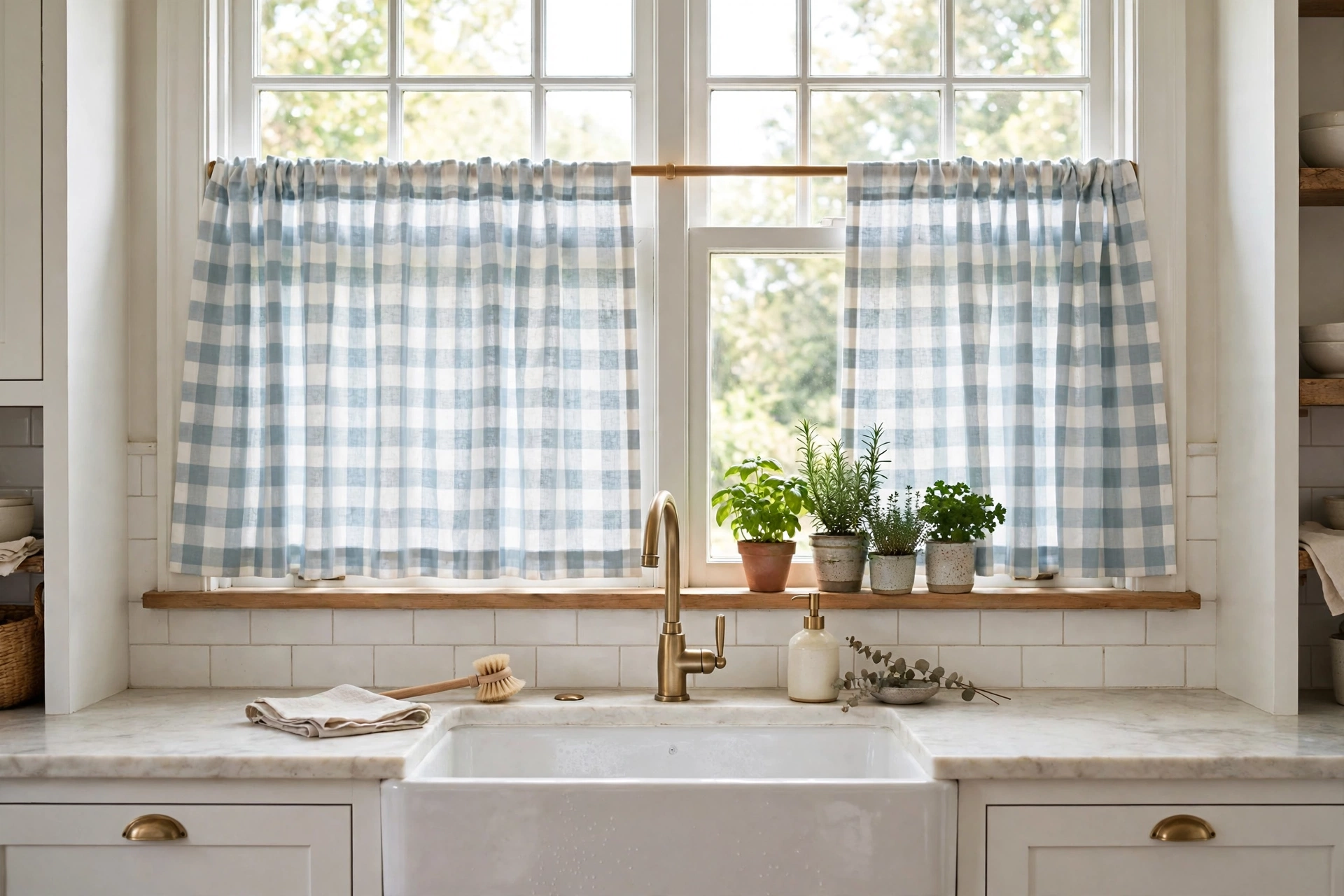
Sill-length curtains end at, or a centimetre above, the windowsill. They belong where longer fabric would get in the way: above kitchen sinks, radiators and deep window seats, and in bathrooms where hems must stay clear of steam and splashes. They read as neat and traditional, and they are the only sensible choice when furniture is built in directly under the window.
Apron Length: Just Below the Sill
Apron-length curtains finish roughly 10 to 15 centimetres below the sill, covering the wall strip beneath the window. It is a forgiving length for uneven floors and older houses, and a good compromise in children’s rooms and home offices where floor length feels fussy but sill length feels abrupt. If a radiator sits under the window, apron length keeps fabric clear of the heat while still covering the fittings.
Floor Length: The Modern Default
Floor-length curtains are the default in contemporary living rooms and bedrooms, and they come in three sub-styles worth knowing. A “float” ends about a centimetre above the floor: clean, practical, and easy to vacuum around. A “kiss” just touches the floor, which looks tailored but demands an exact measurement, because floors are rarely perfectly level. A “break”, borrowed from menswear, adds two or three centimetres so the fabric folds softly onto the floor, relaxed and deliberate. Of all the curtain length rules in this guide, the floor-length family is the one to master first.
Puddle Length: The Deliberate Drama
Puddle curtains carry five to fifteen centimetres of extra fabric that pools on the floor. The look is romantic and formal, suited to dining rooms, main bedrooms and low-traffic windows dressed in linen or velvet. Be honest about maintenance: puddles collect dust, need rearranging after vacuuming, and are a poor idea with toddlers or shedding pets. Used knowingly, though, nothing else delivers the same sense of occasion. Puddle is the exception that proves the curtain length rules: it only looks right when it is unmistakably deliberate, never when it happens by accident.

Curtain Length Rules for Height: How High to Hang
Height is where most people undersell their windows. The governing curtain length rules for placement are simple: hang the pole high, hang it wide, and measure your drop from the pole, never from the top of the window frame.
The classic guideline is to fix the pole halfway between the top of the window frame and the ceiling, or 10 to 15 centimetres above the frame where ceiling height is limited. In a room with low ceilings, take the pole almost to the ceiling line; the long uninterrupted drop of fabric is one of the most reliable tricks for making a room feel taller. In tall rooms, the halfway rule stops curtains from looking like they are sliding down the wall.
Two practical warnings. First, measure the drop after the pole is up, from the underside of the pole or the bottom of the rings, because ring and clip styles add two to eight centimetres you must account for. Second, check what the drill will meet: lintels above windows are often concrete or steel, and the fixings need to suit them. A pole that sags or pulls out will ruin the effect of every other rule on this page.
Bay windows and glazed doors ask for small adjustments rather than new rules. On a bay, either run individual panels on each section with a bay pole that follows the angles, keeping one consistent drop throughout, or hang a single pair outside the bay so the curtains frame the whole alcove. For French and sliding doors, floor length still applies, but choose a float rather than a kiss so the panels clear the doorway in daily use, and extend the pole far enough that the open curtains sit clear of the door swing. The curtain length rules survive both cases; only the hardware changes.
Width and Fullness Rules: How Much Fabric Is Enough
Length gets the attention, but width decides whether curtains look generous or mean. Extend the pole 15 to 30 centimetres beyond the frame on each side, so the open curtains stack back mostly against the wall and leave the glass fully clear. Your window will look wider, and the room keeps all of its daylight.
Fullness is the ratio between the combined width of your panels and the width of the pole. For flat, tailored styles, 1.5 times the pole width is enough. For standard gathered and pencil-pleat curtains, aim for twice the pole width. For eyelet curtains and sheer fabrics, which fall in wide, soft waves, two to two and a half times gives the lush look in photographs. Skimping on fullness is the most common reason home curtains disappoint: the length can be perfect and the window still looks underdressed, because curtain length rules assume the fabric has enough body to fall in folds rather than hang in a flat sheet. Treat the two as one system: the length rules set the drop, and the fullness rules set the fall.

Room-by-Room Curtain Rules
The general rules flex a little by room. Here is how the curtain length rules translate to the spaces where you will actually apply them.
Living Rooms: Go Long and Generous
In living rooms, floor length with a float or a gentle break suits nearly every style, and blackout is rarely needed, so lined cotton, linen-look and wool blends all work. This is the room where curtains act as a soft backdrop to everything else, which is why they pair so well with the other big backdrop decision, the walls themselves; these modern accent wall ideas show how colour and texture behind the sofa change what your curtains need to do.
Bedrooms: Floor Length Plus Blackout
Bedrooms reward floor length for its cocooning feel, and the functional rule is blackout lining or a separate blackout blind behind sheers. If a radiator or a low dresser sits beneath the bedroom window, apron length with blackout lining is the pragmatic exception, and it still looks intentional when the pole is hung high and wide.
Kitchens and Bathrooms: Short, Washable, Clear of Trouble
Humidity, splashes and heat rewrite the rules in these rooms. Sill length, cafe curtains covering the lower half of the window, or blinds paired with a simple valance all keep fabric away from water and hobs. Choose washable fabrics and mould-resistant finishes, and never let a long panel drift near a cooker or an open flame. Kitchen curtain length rules are, in the end, safety rules in disguise.
Rental and Small-Window Exceptions
Renters can honour the spirit of the curtain length rules without drilling: tension rods inside the frame for sheers and cafe styles, and command-strip hooks rated for the weight for lightweight panels. On genuinely small windows, hang the pole at standard height anyway and let sill-length panels frame the glass; a small window dressed by the rules looks deliberate, while one dressed apologetically looks smaller.
How to Measure, Step by Step
Decide the finished length first, using the four lengths above, then measure in this order. Work through the steps without skipping and the curtain length rules become simple arithmetic instead of guesswork. One: fit the pole, or mark its position, at your chosen height and width. Two: measure from the bottom of the pole, or the bottom of the rings if you will use them, down to your chosen endpoint: sill, below-sill point, or floor. Three: for floor length, measure at three points across the window, because floors slope; order for the shortest measurement if you want a float, the longest if you want a break. Four: note the pole width and multiply by your fullness factor to get the total fabric width, then divide by panel widths. If arithmetic is not your friend, a curtain size calculator will run the numbers from your measurements in seconds; just be sure to feed it the pole width, not the window width.
Finally, remember that ready-made curtains come in standard drops, commonly 137, 183 and 229 centimetres in the UK and 84, 96 and 108 inches in the US. Buy the standard drop just longer than your measurement and have it hemmed; shortening is always possible, while adding length is not. That single habit prevents more curtain regret than any other tip in this guide.
A worked example ties it together. Take a window 180 centimetres wide. Extend the pole 25 centimetres on each side and it spans 230 centimetres. At a standard fullness of two, you need about 460 centimetres of fabric, which in ready-made panels usually means two pairs, or one pair of extra-wide panels. If the pole sits 12 centimetres above the frame and the floor-to-pole measurement is 232 centimetres, the 229-centimetre standard drop, hemmed by a centimetre or two, lands exactly at a clean float. Run your own window through the curtain length rules in the same way and the shopping list writes itself.
Five Mistakes That Break the Rules
Most curtain failures trace back to a short list. Curtains that end mid-wall, neither apron nor floor, look like they shrank in the wash. A pole fixed at the frame makes the window, and the room, feel shorter than they are. Panels bought to exactly the window’s width hang flat and mean. Sheers cut to floor length in a steamy bathroom go mildewed at the hem. And curtains pooling in front of a working radiator waste heat and scorch fabric over time. Every one of these is avoided by the measurements above, which is the real point of learning curtain length rules: they are not decoration theory, they are how you avoid buying the same curtains twice.
Hang one window properly, high, wide and to the floor, and you will feel the whole room settle. Then work through the house window by window, applying the same curtain length rules with the room-by-room adjustments. It is one of the most satisfying upgrades in decorating, because the rules do the designing for you: measure honestly, respect the floor, and let the fabric fall.