Gallery wall spacing is the difference between a wall that looks like a designer planned it and a wall that looks like frames were nailed up at random. The art can be beautiful and the frames can match perfectly, yet the wall still looks wrong if the gaps are uneven, too wide or too tight. Get the spacing right and even a modest collection of prints looks intentional. This guide gives you the exact numbers designers use, so your gallery wall looks balanced the first time, without a wall full of spare nail holes.
Why Gallery Wall Spacing Matters More Than the Frames
When a gallery wall looks off, people usually blame the art. They swap prints or buy a new frame, when the real problem is the space between the frames. Gallery wall spacing controls how the eye reads the group: tight, even gaps make separate frames read as one composition, while wide or uneven gaps make them read as unrelated pictures that happen to share a wall. Designers spend more time on spacing than on choosing the art, because spacing is what turns a collection into a display.
8 Gallery Wall Spacing Rules That Always Work
These 8 rules cover every measurement that matters, from the gap between two small frames to the height of a staircase arrangement. They work for grids, salon-style walls, ledges and single rows, whether your frames are all the same size or a complete mix.
1. The 2-to-3-Inch Rule Between Frames
The single most important rule in gallery wall spacing is the gap between frames: 2 to 3 inches, measured edge to edge, and kept the same everywhere. Two inches feels close and connected, which suits modern rooms and tight grids of small frames. Three inches gives each piece more breathing room and suits larger frames and traditional rooms. Either is correct; what matters is picking one and sticking to it.
Go wider than 4 inches and the frames stop reading as a group. Each one becomes a separate picture floating on its own, and the wall starts to look scattered. For a dense grid of small 8 by 10 prints, tighten the gap to 1.5 to 2 inches so the grid reads as one block.
2. Centre the Whole Group at 57 Inches
Gallery wall spacing is not only about the gaps between frames; it is also about where the whole group sits on the wall. Centre the arrangement, not any single frame, at 57 to 60 inches from the floor. That is average adult eye level, and it is the height museums use, because it lets you take in the whole display without tilting your head.
The most common mistake is hanging the wall too high. People centre the group on the wall itself, or measure from the top of the highest frame, and the result floats near the ceiling. Work out the total height of your planned arrangement, halve it, and mark that point at 57 inches from the floor.
3. Keep 6 to 8 Inches Above Furniture
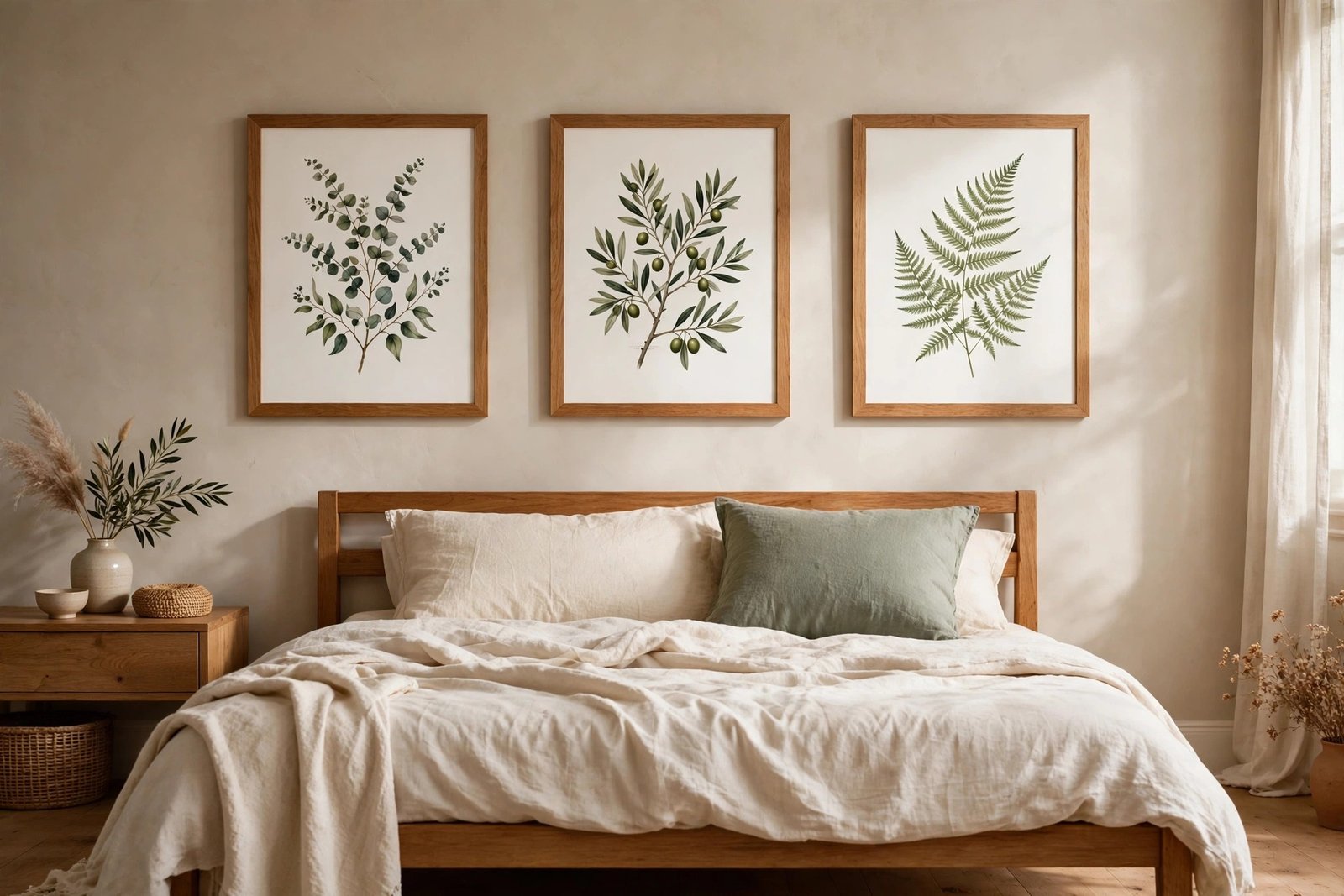
When a gallery wall hangs above a sofa, bed or console, the floor stops being the reference and the furniture takes over. The gallery wall spacing rule here is simple: leave 6 to 8 inches between the top of the furniture and the bottom of the lowest frame. That gap is small enough to tie the art to the piece below it, so the two read as one arrangement, and large enough that nobody knocks a frame when they sit down.
Above a bed or a low dresser you can stretch the gap to 7 to 10 inches without losing the connection. Above a sofa, stay closer to 6 inches, because cushions shift and people lean back. If the gap grows past 10 inches, the art and the furniture stop talking to each other.
4. Span Two-Thirds of the Furniture Below
The width of a gallery wall should relate to the furniture beneath it. In good gallery wall spacing, the whole arrangement spans roughly two-thirds of the width of the sofa, bed or console below it. On an 84-inch sofa, that means a group about 56 to 63 inches wide. On a 60-inch console, aim for about 40 inches of art. Centre the group on the furniture, not on the wall, because the furniture is what the eye uses as the anchor.
A group that is too narrow looks lost above a wide sofa, and a group wider than the furniture overwhelms it. On an empty wall with no furniture below, aim for the group to fill 50 to 75 percent of the available wall width, leaving a comfortable margin on each side.
5. Match the Gap in Grids, Vary It in Salon Walls
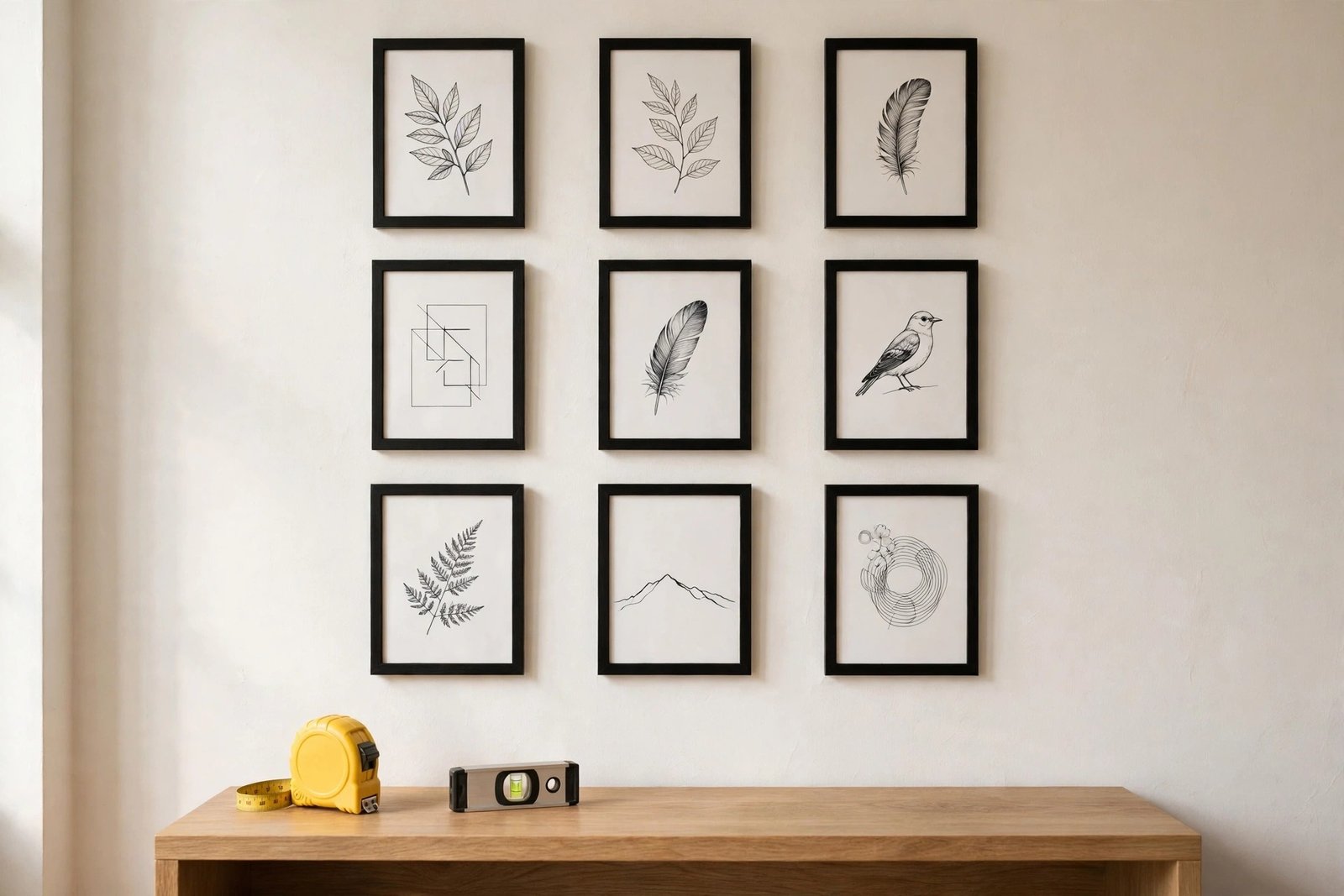
Formal grids and relaxed salon walls follow different spacing logic. In a grid, where every frame is the same size, the horizontal and vertical gaps must be identical at every intersection. If the horizontal gap is 2.5 inches, the vertical gap must be 2.5 inches too. Even a half-inch difference shows, because the eye expects perfect regularity.
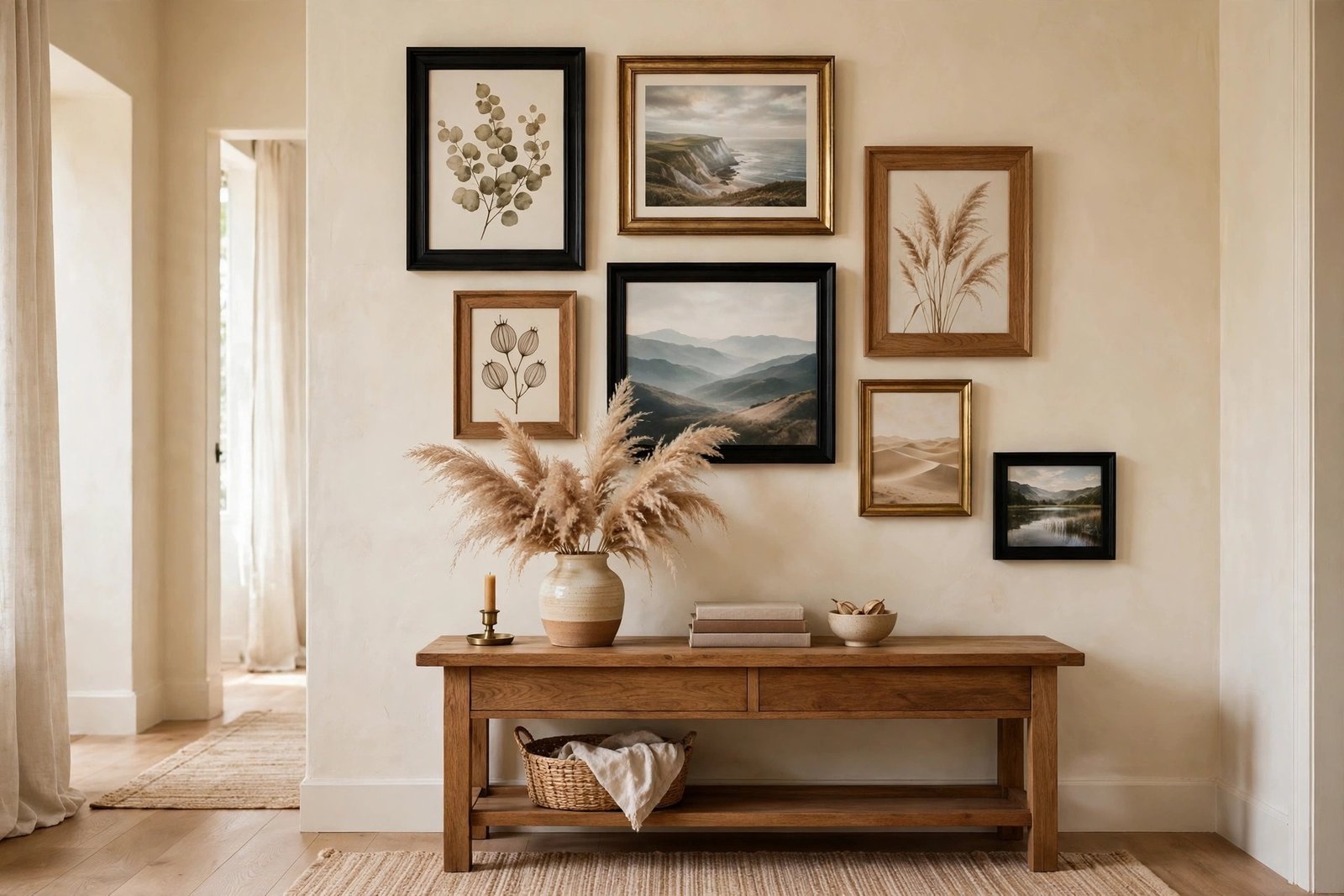
Salon walls, where frames of different sizes are arranged organically, are more forgiving. Let the gap grow a little around the largest frames, say 3 to 4 inches, and tighten it to 2 inches between the smallest ones, as long as the change feels gradual. Choose your smallest and largest gap in advance, for example 2 and 3.5 inches, and never go outside them.
6. Measure Edge to Edge, Never Nail to Nail
One of the most practical rules in gallery wall spacing is also the easiest to get wrong: measure from frame edge to frame edge, never from nail to nail. Frames hang from wires, D-rings or sawtooth hangers that sit at different heights, so the distance between two nails tells you nothing about the distance between the frames.
Mark the frame edges on the wall with painter’s tape, then measure the gap between the tape lines. Better still, build the whole arrangement on the floor first, measure the gaps there, and transfer the layout to the wall using paper templates cut to the size of each frame. Mark the nail position on each template and step back to check the composition before you pick up the hammer.
7. Leave Breathing Room at the Edges
Good gallery wall spacing needs space around the group, not just between its frames. Leave at least 6 inches, and ideally 8 to 12 inches, between the outermost frames and the nearest corner, ceiling, door frame or furniture beside the wall. Without that margin, the arrangement looks cramped, as if it grew too big for the wall.
This matters most on small walls and in hallways, where the temptation is to use every inch. A slightly smaller arrangement with clean margins looks far more professional than a larger one squeezed into the corners. If your planned layout does not leave those margins, remove a frame or two rather than shrinking the gaps.
8. Test the Layout on Paper First
The final rule is a process rule: never hang a frame before you have seen the whole arrangement on the wall. Cut kraft paper to the size of each frame, mark where the nail goes, and tape the sheets to the wall using the measurements above. Live with the paper version for a day if you can, and look at it from the doorway and from the sofa.
Paper templates reveal problems measuring alone will miss: a frame that sits awkwardly high, a gap that looks bigger in reality than on paper, or a composition that leans to one side. They also let you adjust the gallery wall spacing without new holes. Shift a template half an inch, re-check the gaps, and only pick up the hammer when the paper wall looks right.
Gallery Wall Spacing by Layout: Grid, Salon and Ledge
Different layouts ask different things of your spacing. A grid is the most disciplined: identical frames, identical gaps, and a rectangular outer shape. It suits modern and minimalist rooms, and it is the easiest layout to get right, because the rules are absolute. Use 2 to 3 inches between every frame and keep the outer edges straight.
A salon wall is looser and more personal, mixing sizes, orientations and frame styles around one anchor piece, usually the largest frame. Here, gallery wall spacing becomes a matter of balance: keep the gaps between 2 and 4 inches, let the biggest frames have the widest gaps, and step back often to check the overall shape. If you want inspiration for your first gallery wall, our gallery wall ideas for the living room show grids, salon walls and ledge displays in real rooms, so you can see how each layout handles spacing before you commit.
Picture ledges are the forgiving option. Frames lean on a narrow shelf rather than hanging from nails, so you can slide them along until the spacing looks right and swap pieces in seconds. Keep the same 2 to 3 inch gaps between leaning frames, and let the front row overlap the back row slightly for depth.
Gallery Wall Spacing for Tricky Spots: Stairs, Hallways and Small Walls
Staircases break the normal rules, because the floor is not level. The centre of the arrangement should follow the slope of the stairs, rising step by step, with each frame’s centre roughly 57 inches above the tread directly below it. Keep the gallery wall spacing consistent when measured perpendicular to the slope, not horizontally, or the wall will look as if it is sliding downhill. Run a strip of painter’s tape up the wall parallel to the stair slope and use it as your centre line.
Hallways are narrow, so the viewing distance is short and wide gaps look bigger than they are. Tighten the spacing to 1.5 to 2 inches and keep the whole arrangement compact, ideally no more than 60 inches wide.
How to Measure and Mark Your Spacing
Accurate gallery wall spacing starts with the right tools, and none of them is expensive: a steel tape measure, a spirit level, a pencil, painter’s tape and a roll of kraft paper. Measure the wall and the furniture below it, then work out your total arrangement width by adding the frame widths plus the gaps. Four 16-inch frames with 3-inch gaps make a row 73 inches wide. If that is wider than two-thirds of your sofa, drop a frame or shrink the gaps to 2 inches.
Mark the centre of the arrangement with a small pencil dot at 57 inches from the floor, then build outward, marking each frame edge with tape. Check every gap before you drill, and use the spirit level on every frame; a frame half an inch out of level makes the gap beside it look wrong even when the measurement is right. For a detailed walkthrough with diagrams, this gallery wall spacing guide covers the exact gaps, widths and layouts, and it is a useful second opinion before you hang anything.
Mistakes That Ruin Gallery Wall Spacing
The most common mistake is hanging frames too far apart. Gaps of 5 or 6 inches turn a group into scattered pictures, and the fix is almost always to bring everything closer together rather than to add more art. The second mistake is uneven gaps: one gap of 2 inches next to one of 4 inches reads as a mistake even if nobody can say why the wall looks wrong.
The third mistake is hanging the whole group too high, which usually happens when people centre the arrangement on the wall instead of at eye level. The fourth is ignoring the furniture below: art that floats a foot above a sofa looks disconnected.
How Much Does a Gallery Wall Cost?
Gallery wall spacing costs nothing; the frames and hardware are where the money goes, and even those can stay modest. A set of six matching frames in standard sizes costs roughly £40 to £90 in the UK, or $50 to $120 in the US. Individual statement frames run £15 to £40 each, and a pack of picture hooks costs under £10. Add kraft paper and painter’s tape for about £10 more.
If you are buying prints too, budget £10 to £30 per print, or print your own photographs for a few pounds each. Hiring a professional picture hanger costs £100 to £250 in the UK, or $150 to $350 in the US, but with the measurements in this guide most people can hang a gallery wall themselves in an afternoon.
Final Thoughts: Spacing Is the Whole Secret
Good gallery wall spacing is not a talent; it is a set of numbers, and now you have them. Two to 3 inches between frames, a group centred at 57 inches, 6 to 8 inches above the furniture, and a width about two-thirds of the piece below.
Start with the paper templates, take your time with the tape measure, and step back often. The frames you already own will look better the moment the gaps between them are even. That is the secret of gallery wall spacing, and now it is yours.