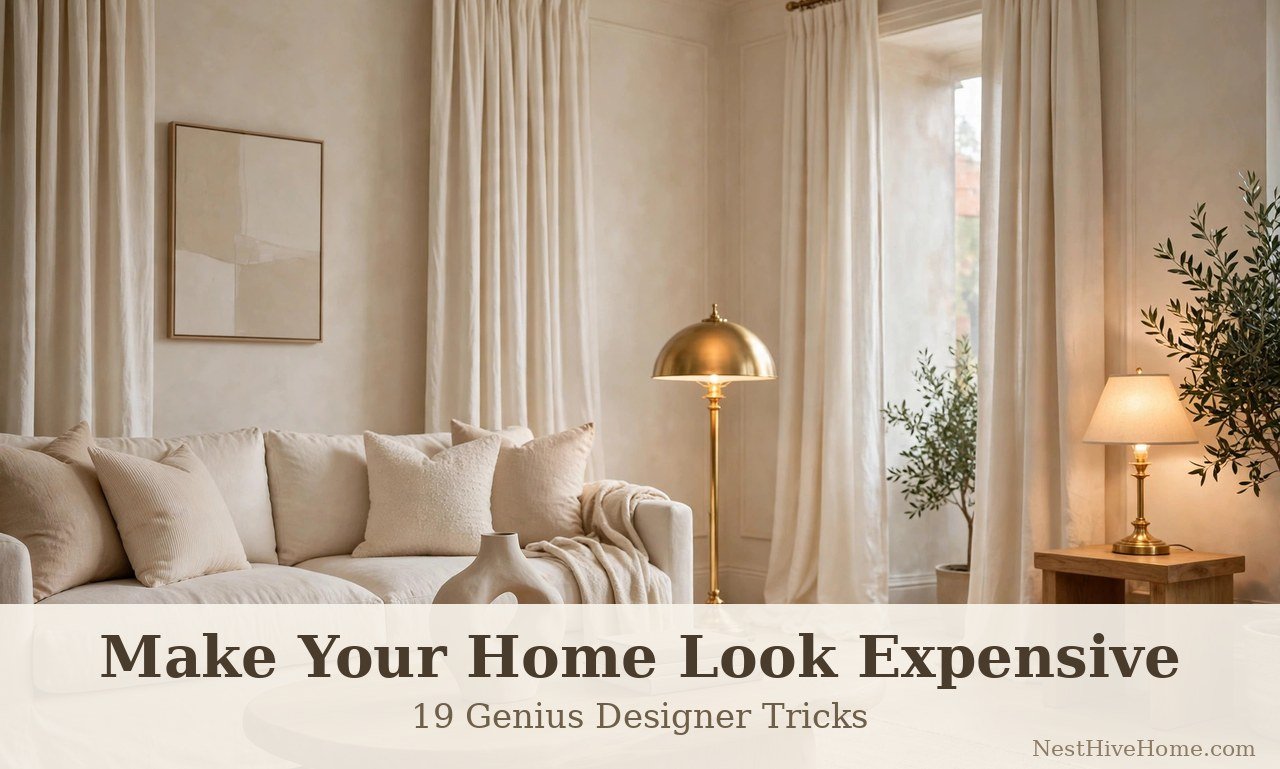
How to Make Your Home Look Expensive: 19 Designer Tricks That Actually Work
How to make your home look expensive has surprisingly little to do with how much you spend. Walk into a truly expensive-feeling home and look closely: the furniture is rarely all designer, and the rooms are rarely large. What those rooms have is editing, scale and light — three things that cost far less than a renovation. Designers know that “expensive” is a set of visual signals, and every one of those signals can be copied on an ordinary budget.
This guide gives you 19 of those signals, in the order a designer would apply them: free fixes first, then lighting, scale, colour and the small details people touch every day. None of them needs a contractor. Most need a free weekend and a tape measure. Work through them one section at a time and your home will start reading as considered and calm — which is what expensive really looks like.
Once you see how to make your home look expensive as a set of signals rather than a shopping list, the order of work becomes obvious — and most of it is free.
Start With the Free Fixes (Tricks 1–3)
1. Edit ruthlessly before you buy anything. Expensive rooms have empty space in them. Clutter is the single loudest “cheap” signal there is, because it makes every object look accidental. Clear every surface, then put back only what earns its place. If you are learning how to make your home look expensive, this is the lesson underneath all the others: restraint is the luxury.
2. Pull the furniture off the walls. Pushing every piece against the wall leaves a dead, empty middle and makes a room feel like a waiting room. Bring the sofa in by even 10 to 15 cm (4 to 6 inches), anchor the seating group on a rug, and let the pieces relate to each other instead of the walls. Conversation groupings look intentional, and intentional is what reads as expensive.
3. Use symmetry where you can. A pair of matching lamps, two chairs balanced either side of a fireplace, cushions arranged as a mirror image — symmetry calms the eye and makes a room feel planned. It does not have to be perfect. One strong symmetrical moment per room, usually around the sofa or the bed, does most of the work.
How to Make Your Home Look Expensive With Lighting (Tricks 4–7)
If you change only one thing, change the light. Ask any designer how to make your home look expensive on a small budget and lighting is the answer that comes back first, because it changes how every other thing in the room is judged. Good Homes Magazine’s round-up of designer tricks for a more expensive look makes the same point designers make everywhere: layered lighting is what gives high-end homes their atmosphere.
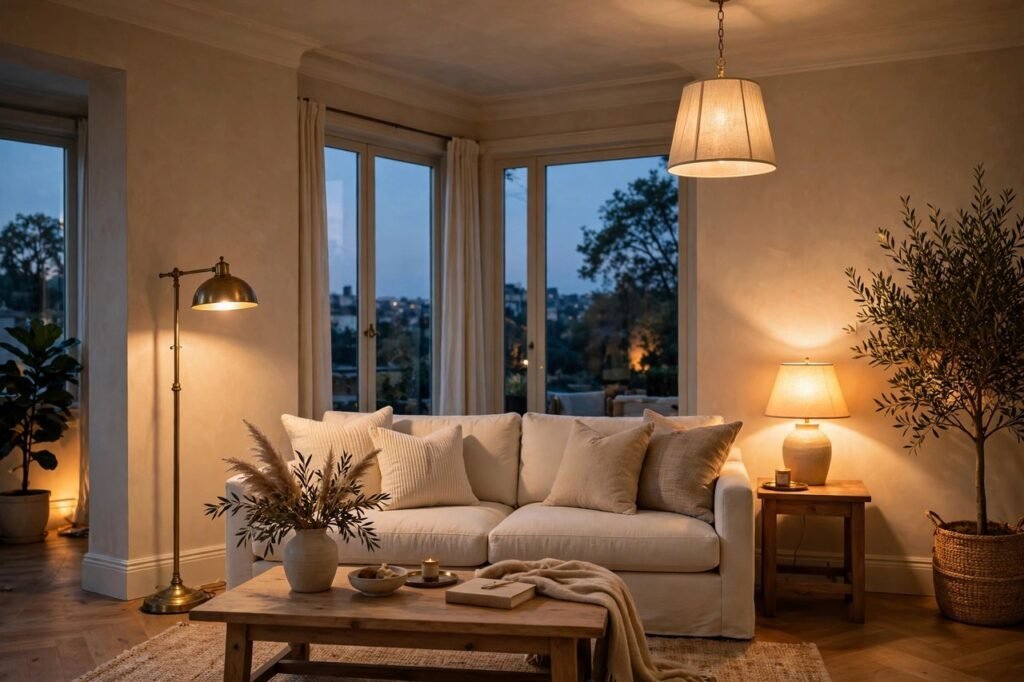
4. Layer three sources in every room. One ceiling light flattens everything it touches. Aim for three layers instead: general light from above, task light where you read or work, and low accent light from table lamps that pools in corners. Three sources at three heights is the hotel formula, and it works in a studio flat as well as a house.
5. Make every bulb the same warm temperature. Mixed bulbs — one cool white, one warm — make a room feel disjointed and cheap in a way people sense without knowing why. Standardise on warm white, around 2700K, in living spaces. It flatters wood, skin and fabric, and consistency across a room instantly feels deliberate.
6. Go bigger with one statement fixture. A too-small pendant or a builder-grade ceiling light is a giveaway. One oversized pendant over the dining table or a generous sculptural shade in the living room claims the ceiling the way expensive homes do. Scale it up beyond what feels safe; fixtures almost always look smaller once hung than they did in the shop.
7. Put lamps on dimmers or use warm, low light in the evening. Bright, even light is functional; low, varied light is luxurious. Dimmer plugs for table lamps cost very little and let a room drop into that soft evening glow that makes everything — furniture, faces, food — look better.
Scale and Proportion: Think Bigger (Tricks 8–11)
After light, scale is the second signal. Undersized pieces — a small rug, short curtains, a row of tiny frames — make even good furniture look like it was bought in a hurry. Here is how to make your home look expensive simply by sizing the main pieces correctly.
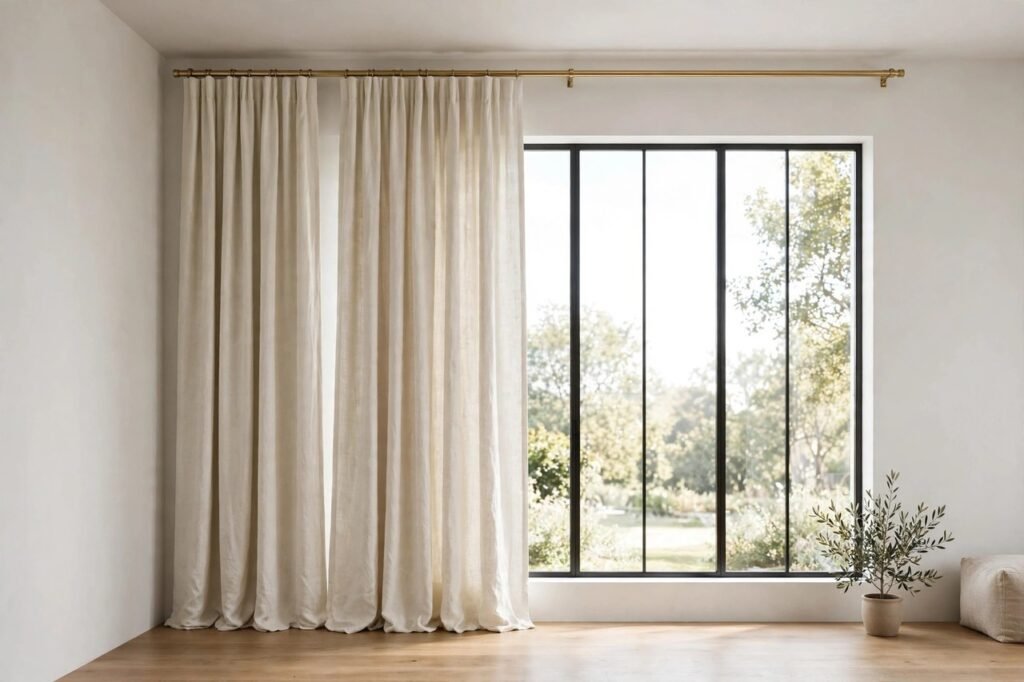
8. Hang curtains high and let them reach the floor. This is the most reliable trick in the whole list. Mount the curtain rod close to the ceiling, not just above the window frame, extend it wider than the window, and let the fabric finish at the floor — just touching or pooling by a centimetre or two. The window reads as architecture, the ceiling reads as higher, and the room reads as designed. Short curtains that stop at the sill do the opposite every time.
9. Size the rug up, not down. A small rug floating in the middle of the floor makes a room look underfunded. The rug should sit under at least the front legs of the sofa and chairs; in most living rooms that means 160 × 230 cm (roughly 5 × 8 ft) at minimum, and 200 × 300 cm (8 × 10 ft) is better. A large, inexpensive natural-fibre rug under everything looks far more expensive than a small, pricey one under nothing.
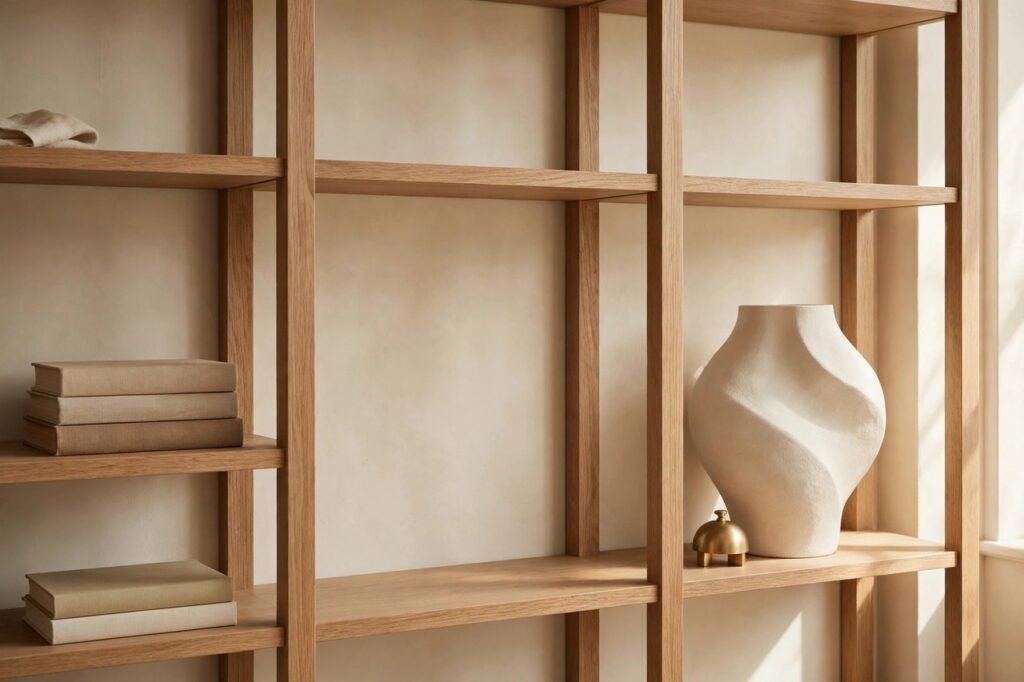
10. Choose fewer, larger pieces. Ten small ornaments look like clutter; one large sculptural vase looks like a decision. The same goes for art: a single oversized piece, or one tight gallery grouping with generous spacing, feels gallery-like, while small frames scattered at random heights feel accidental. When you wonder how to make your home look expensive with what you already own, the answer is often to remove half the small things and promote the biggest one.
11. Raise the visual weight of the sofa. Sofas anchor rooms, so small upgrades there pay off: plump, well-filled cushions with proper inserts, a throw folded with intention over one arm, and cushion covers in linen, velvet or wool rather than thin shiny fabric. A sofa that looks comfortable and structured makes the whole room feel expensive.
Colour and Texture That Read as Luxury (Tricks 12–14)
Colour is where most people reach for more, when the real answer is usually less. Knowing how to make your home look expensive with colour means repeating a few tones with confidence instead of collecting new ones.
12. Edit your palette to two or three tones. Expensive rooms repeat a tight palette: one soft neutral, one deeper anchor colour, one metal finish. When every room invents its own colours, the home feels restless. Choose your three and let them repeat — the anchor colour in a cushion here, a vase there, a throw in the next room — and the whole home starts to feel designed as one piece.
13. Add one deep, confident colour. All-pale rooms can feel washed out rather than luxurious. A single deep tone — forest green, inky navy, charcoal, oxblood — on one wall, a sofa or a set of curtains gives a scheme its backbone. Our forest green living room decor guide shows how one deep colour lifts cream furniture, warm wood and brass around it.
14. Layer texture, not more colour. Depth comes from surfaces: bouclé against smooth linen, rough jute underfoot, warm oak beside cool stone, a nubby wool throw over a leather chair. Five or six textures inside a tight palette feel rich; five or six colours in one texture feel noisy. Touch is the sense that convinces people a room is expensive, so give it something to work with.
The Details People Touch Every Day (Tricks 15–17)
Small details are the quiet proof. Guests may never comment on a new sofa, but their hands register solid handles and their eyes register tidy surfaces — which is exactly how to make your home look expensive without a single big purchase.
15. Upgrade the hardware. Door handles, cabinet knobs and drawer pulls are the jewellery of a home — small, touched constantly, and judged subconsciously. Swapping dated or lightweight hardware for solid-feeling brass, matte black or aged bronze transforms kitchens and wardrobes for the price of a takeaway dinner per room. Keep one finish per room and repeat it.
16. Hide the wires and the workings. Visible cable nests, extension leads and router lights undo expensive signals instantly. Run cables in trunking or behind furniture, corral chargers in one lidded box, and give the television a considered backdrop rather than a tangle — a styled console or a painted wall behind it changes how the whole setup reads.
17. Style surfaces in threes, with space around them. On a coffee table or console, group a stack of books, one taller object and one small natural thing — then stop. The styling formula in our luxury coffee table ideas is the same one designers use: vary the heights, corral with a tray, and leave empty surface showing. Empty space around objects is not wasted; it is what makes the objects look chosen.
Walls That Look Architectural (Tricks 18–19)
18. Give one wall a treatment, not just a colour. Panelling, slats, picture-frame moulding or even a confident block of limewash paint adds the shadow lines and structure that flat painted walls lack — and structure is architecture’s signal for quality. Our accent wall ideas for the living room walk through paint, panelling and wallpaper options at several budgets, including renter-friendly versions that come down in an hour.
19. Hang one large mirror where it borrows light. A big mirror opposite or beside a window doubles the daylight in a room and makes the space feel larger and calmer. Choose a frame with some presence — warm wood, brass or a deep painted finish — and hang it at the height art would hang, not up near the ceiling. It is the closest thing to adding a window without a builder.
What Not to Spend On First
A quick warning before the plan, because it saves real money. Do not start by buying more accessories, more cushions or a new statement chair. New objects dropped into an unedited, badly lit room inherit the room’s problems, and this is where most decorating budgets quietly disappear. The homeowners who learn how to make your home look expensive — properly, the way designers mean it — almost always say the same thing afterwards: the transformation happened when they fixed light, scale and editing, and the shopping they did afterwards was smaller than they expected.
A Weekend Plan, in the Right Order
Knowing how to make your home look expensive matters less than doing the fixes in the right order, because the free ones change what you need to buy. Saturday morning: edit and declutter one room (trick 1), pull the furniture into a grouping (2), and fix symmetry around the sofa or bed (3). Saturday afternoon: standardise the bulbs, add the lamps you already own from other rooms, and hang the curtains high (4, 5, 8). Sunday: style the surfaces in threes, hide the cables, and swap one set of hardware (15, 16, 17).
Budget tiers help you stop at the right place. At $0 / £0, tricks 1–3, 14 and 17 already transform a room. At around $50–$100 / £40–£80, add matching warm bulbs, a dimmer plug, curtain repositioning and one hardware set. At $200–$300 / £150–£250, the larger rug or the statement light fixture is the purchase that changes the room’s category in visitors’ eyes. Spend on scale and light before you spend on objects — that order is the whole secret.
The Short Version
How to make your home look expensive is a discipline, not a purchase: edit first, light in layers, scale up the rug, curtains and art, hold a tight palette, layer texture, and sweat the small hardware people touch. Do those things and mid-priced furniture looks considered, small rooms look calm, and guests will assume you spent far more than you did. Start this weekend with the free tricks — by Sunday evening your home will already feel different.