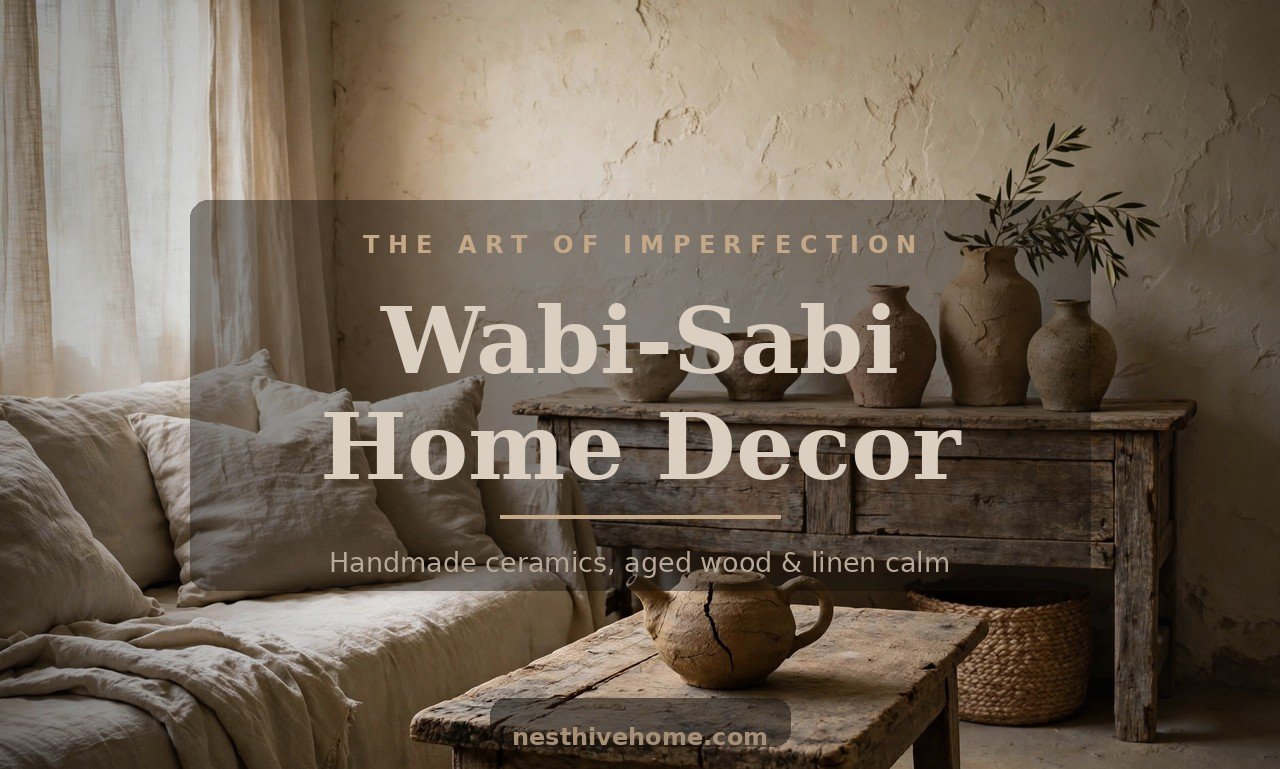
Wabi-sabi home decor is the art of finding beauty in imperfection. Rooted in a centuries-old Japanese philosophy, it celebrates cracked glazes, weathered wood, uneven handmade pottery, and the soft patina that only time can create. Instead of chasing a showroom-perfect finish, this approach invites you to keep the pieces that carry a story and let your home age gracefully alongside you.
If your home feels too polished, too matched, or too afraid of a scratch, wabi-sabi home decor offers a calmer way forward. It is not about neglect or clutter. It is about choosing fewer, better things made from honest materials, and letting their natural flaws become the decoration. The result is a space that feels warm, grounded, and deeply personal rather than staged.
In this guide, you will find 15 practical ideas for bringing wabi-sabi home decor into every room, from limewashed walls and handmade ceramics to linen bedding and aged wooden furniture. Most of these ideas cost little, and several cost nothing at all, because the style rewards what you already own.
What Wabi-Sabi Home Decor Really Means
Three ideas sit at the heart of the style. First, nothing lasts forever, so materials that show their age are valued rather than hidden. Second, nothing is finished or perfect, so asymmetry and rough edges are welcome. Third, nothing is complete without nature, so wood, stone, clay, linen, and wool take priority over plastic and high-gloss finishes.
Applied to wabi-sabi home decor, this means a palette drawn from the landscape: warm cream, soft stone grey, clay, sand, muted sage, and deep walnut brown. It means furniture with visible grain, textiles that wrinkle beautifully, and objects made by hand rather than by machine. A wabi-sabi room is quiet, not empty, and every object in it has earned its place.
Start with Nature: Walls, Floors, and Light
1. Limewash Your Walls for Soft, Living Texture
Flat, uniform paint is the enemy of wabi-sabi home decor. Limewash, a mineral paint made from crushed limestone, dries with subtle movement, cloudy depth, and a chalky matte finish that changes as daylight moves across it. One feature wall in a warm cream or pale clay tone can transform a whole room.
A 2.5-litre tin typically covers around 25 square metres and costs $40–$70 / £35–£60. Apply it with a block brush in loose, crisscross strokes rather than neat roller lines. The slight unevenness is the point. Pair limewashed walls with raw wood and linen, and avoid glossy trim paint nearby, which fights the soft finish.
2. Let Wooden Floors Show Their Age
Scuffs, knots, and colour variation are exactly what make a wooden floor beautiful in wabi-sabi home decor. If your boards are already worn, resist the urge to sand them back to uniform perfection. A light coat of natural hardwax oil protects the surface while keeping the grain visible and touchable.
For a budget-friendly route, look for reclaimed or seconds-grade boards, which often cost 20–40% less than premium planks and carry far more character. In kitchens and hallways, a simple woven jute or sisal runner softens the look without hiding the wood beneath it.
3. Choose Soft, Diffused Light Over Bright Overhead Glare
Harsh ceiling lights flatten texture and expose every flaw in an unforgiving way. Wabi-sabi rooms glow instead. Use paper lanterns, linen-shaded table lamps, and candles to create pools of warm light at different heights, and keep bulbs at 2700K or below for a candle-like warmth.
During the day, sheer linen curtains filter sunlight into a soft haze that flatters rough plaster and aged wood beautifully, a hallmark of wabi-sabi home decor. If you have one overhead fitting, put it on a dimmer and use it only for cleaning or tasks, never as the room’s main mood.
4. Bring the Outside In with Branches and Dried Grasses
A single branch in a tall stoneware vase can anchor an entire corner. Unlike fresh flower arrangements, dried grasses, eucalyptus stems, and bare branches last for months, cost almost nothing, and change slowly with the seasons, which is precisely the spirit of wabi-sabi home decor.
Forage responsibly or buy a small bunch of pampas or dried lavender for $10–$20 / £8–£15. Keep arrangements sparse and slightly asymmetric: three stems of different heights look more natural than a dense, symmetrical bouquet. A chipped vase only adds to the charm.
Handmade Pieces with Soul
5. Build a Collection of Handmade Ceramics
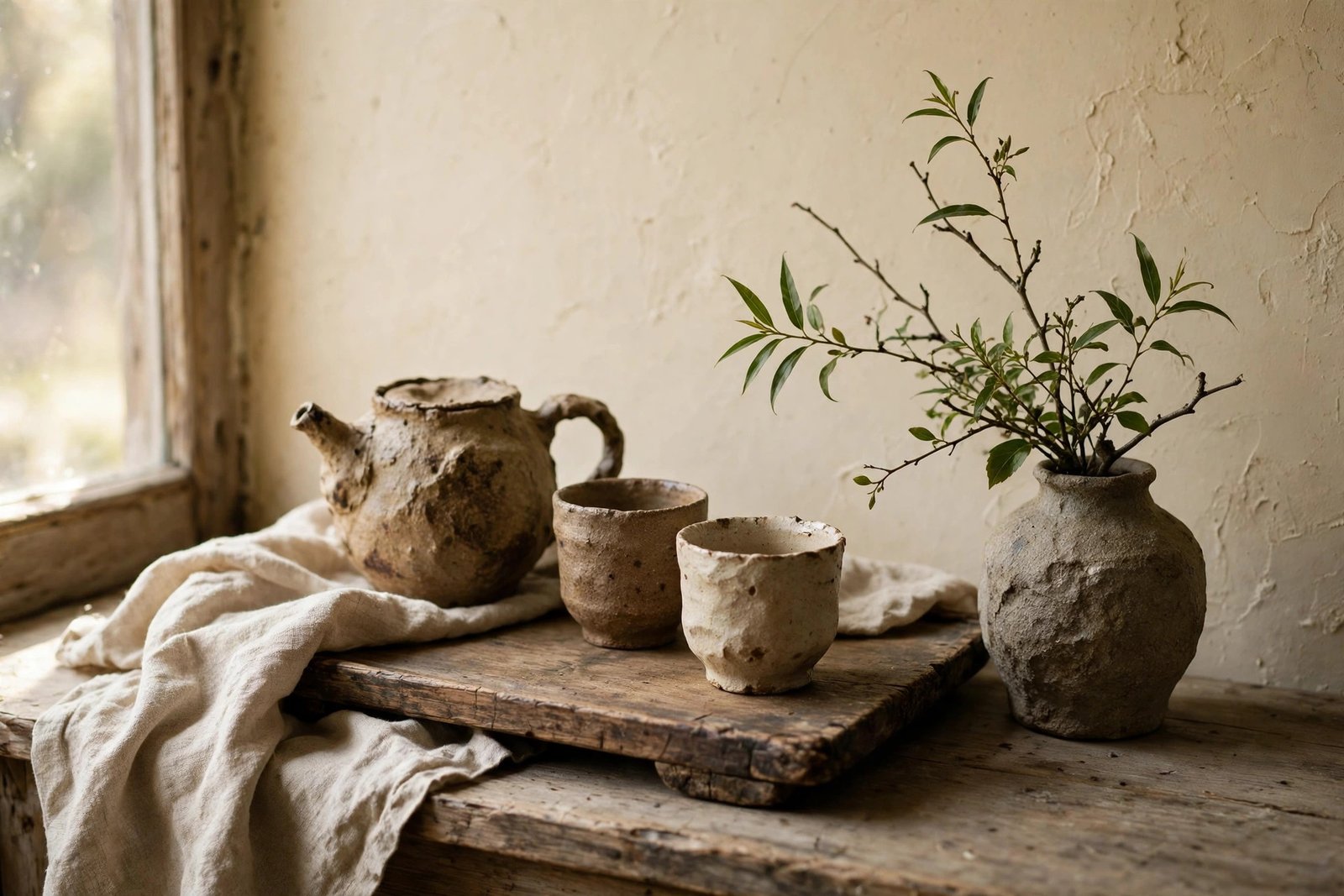
No single purchase says wabi-sabi home decor more clearly than handmade pottery. Look for stoneware bowls, cups, and vases with uneven rims, visible throwing rings, speckled glazes, and small firing marks. Each piece should feel slightly different from the next, because a maker’s hands are not a factory line.
Start with everyday pieces you will actually use: two or three bowls, a teapot, and a vase. Studio pottery at craft markets often starts at $15–$30 / £12–£25 per piece, and thrift shops are full of overlooked handmade ceramics for a few dollars. Display them openly on a wooden shelf rather than behind glass, where their imperfections stay visible — that visibility is the essence of wabi-sabi home decor.
6. Create a Quiet Tea Corner
A tea corner is a wabi-sabi home decor ritual made visible. Choose a low wooden tray, a handmade teapot, two mismatched cups, and a small cloth in natural linen. Place the group near a window where morning light can fall across it, and keep the arrangement simple enough to use every day.
The beauty of this idea is that it costs very little and changes how you use the room. A five-minute tea ritual in a calm corner turns an ordinary morning into a small ceremony, and the worn tray and stained cups will only grow more beautiful with use.
7. Repair Instead of Replace with Visible Mending
The Japanese art of kintsugi repairs broken pottery with gold lacquer, turning a crack into the most beautiful part of the piece. You can borrow the same thinking throughout your home: mend a torn linen cushion with visible stitching, oil a scratched tabletop instead of replacing it, and keep the chair with the wobbly leg once it is safely fixed.
Kintsugi repair kits cost around $20–$35 / £15–£30 and make a wonderful weekend project for a favourite bowl or cup. The repaired piece becomes a conversation starter and a daily reminder that damage does not mean the end of something’s value.
8. Choose Handwoven Textiles Over Machine-Perfect Fabric
Handwoven throws, rag rugs, and raw linen curtains carry tiny irregularities in their weave that machine-made fabric cannot imitate. These small variations catch light differently and make a room feel touched by human hands rather than assembled from a catalogue.
Look for cotton or wool throws in undyed or naturally dyed tones, and layer them loosely rather than folding them into sharp rectangles. A slightly rumpled linen throw over a sofa arm is not messy in wabi-sabi home decor; it is an invitation to sit down.
Soft, Lived-In Living Spaces
9. Embrace Aged and Reclaimed Wood Furniture
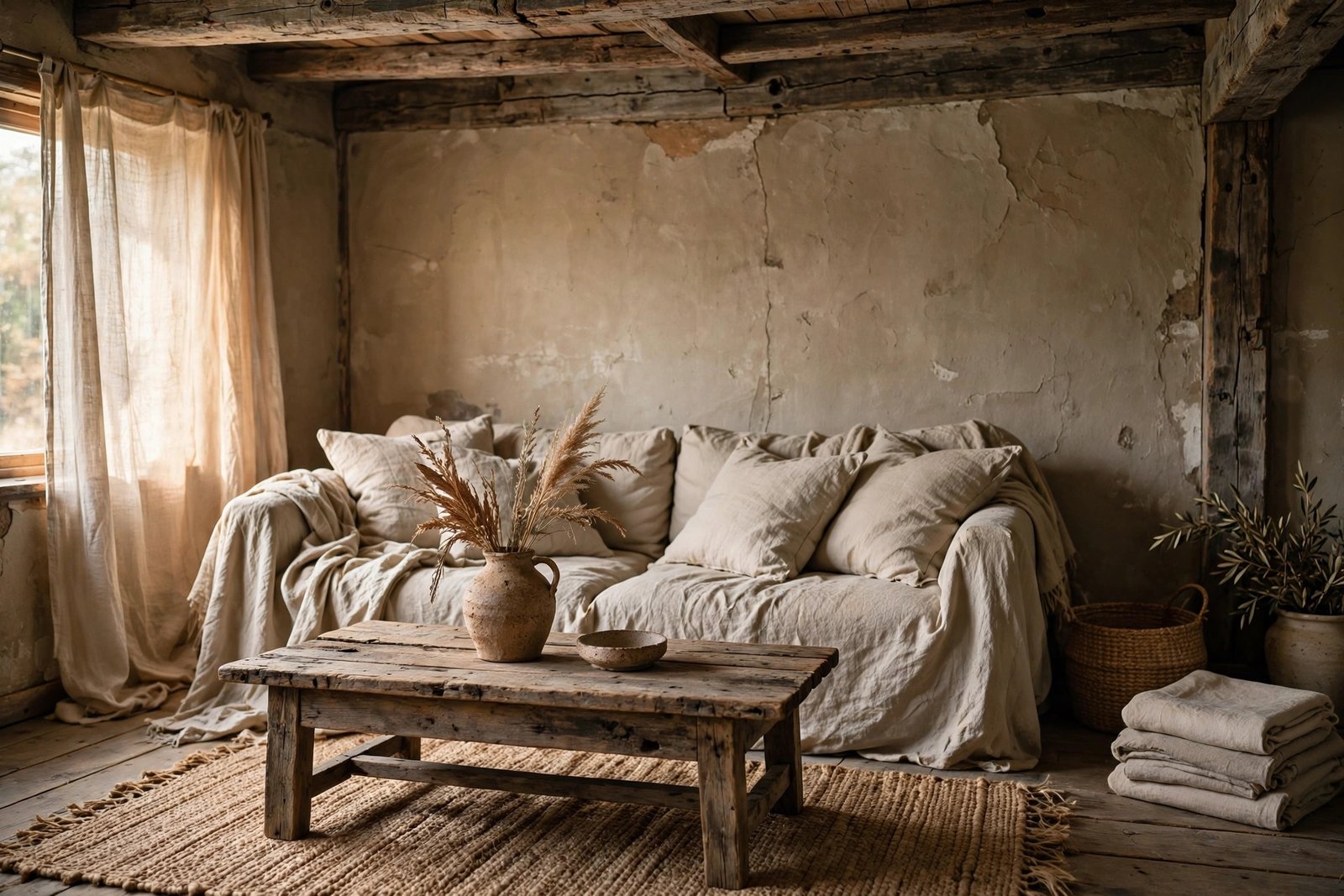
A reclaimed wood coffee table with knots, nail holes, and a weathered edge brings instant warmth that new furniture takes years to develop. Search second-hand shops, salvage yards, and online marketplaces for solid wood pieces with honest wear, and check that joints are sturdy before you buy.
If a piece is too glossy, a light sanding followed by beeswax or matte oil will calm the finish. Avoid matching sets: wabi-sabi home decor mixes a weathered oak table, a rattan chair, and a linen sofa, and the variety is what makes the room feel collected over time rather than bought in one afternoon.
10. Layer Linen, Wool, and Cotton for Tactile Comfort
Texture does the decorating in wabi-sabi home decor, so layering matters more than colour matching. Combine a washed linen sofa cover, a chunky wool throw, a cotton cushion in a muted tone, and a handwoven rug, and let the different surfaces invite touch.
Keep the palette restrained so the textures can speak: oat, stone, sage, clay, and charcoal work beautifully together. Wash linen without ironing it, and let wool throws keep their natural loft. The goal is a sofa you sink into, not one you are afraid to crease.
11. Keep Only What You Love, and Give It Room to Breathe
Wabi-sabi home decor is not minimalism for its own sake, but it does ask you to edit. Walk through each room and remove anything you keep out of habit rather than affection. What remains should have space around it: a single vase on a sideboard, one stack of books, a clear stretch of wall.
This breathing room is what lets natural materials shine. A handmade bowl looks ordinary crammed between ten ornaments; alone on a wooden shelf, it becomes a small sculpture. If you are unsure about an object, put it away for a month and notice whether you miss it.
12. Mix Old and New Without Hiding the Difference
In wabi-sabi home decor, a room is allowed to contain a modern sofa beside a grandmother’s wooden stool. The contrast is part of the story, and trying to disguise the age gap with matching covers or paint usually weakens both pieces. Let the old stay old and the new stay new.
The trick is a shared palette and shared materials. A contemporary linen sofa and a century-old oak chest sit comfortably together when both are in warm, muted tones. For a related calming look, explore this japandi bedroom decor guide, which pairs Japanese simplicity with Scandinavian warmth in a similar spirit.

Small Details, Lasting Calm
13. Celebrate Handmade Pottery in the Kitchen
Move your favourite handmade pieces out of the cupboard and into daily use. A speckled stoneware bowl makes breakfast feel considered, and a rough ceramic mug turns an ordinary coffee into a small pleasure. Pottery that is used develops its own patina of tiny marks and stains, and that history is the point.
Choose stoneware and ceramics that are food-safe and dishwasher-friendly if you want them in constant rotation, and keep one or two delicate pieces for display only. Open shelving in natural wood shows the collection off best, and the slight mismatch of shapes and glazes is exactly what makes the shelf interesting.
14. Use Stone, Clay, and Raw Plaster Accents
Small natural accents ground a room in a way that plastic accessories never can. A rough stone paperweight, a terracotta dish for keys, a clay incense holder, or a plaster candleholder adds weight and texture to shelves and side tables without adding visual noise.
Keep these accents few and in earthy tones, and let them sit where they will be touched and used rather than only looked at. In wabi-sabi home decor, a stone bowl that holds everyday objects earns its place far more than a decorative item that serves no purpose at all.
15. Let Your Home Age Gracefully, and Stop Chasing Perfection
The final idea is a mindset rather than a purchase. Accept that linen will wrinkle, wood will darken, ceramics will chip, and walls will mark, and decide to see those changes as your home’s biography rather than its flaws. Touch up what is genuinely damaged, and leave the rest alone.
This shift saves money as well as stress. When you stop replacing things at the first sign of wear, you buy less, choose better, and live more calmly among objects that have truly become yours. That quiet confidence is the deepest reward of wabi-sabi home decor, and it costs nothing at all.
Bringing It All Together
Start with one room and one change: limewash a wall, replace a glossy vase with a handmade one, or swap harsh lighting for warm lamps. Live with that change for a week before adding the next, and let the room teach you what it needs. Wabi-sabi home decor grows slowly, like the patina it celebrates.
For more inspiration on the philosophy behind the style, the Homes & Gardens guide to the wabi-sabi interior design trend explains its Japanese roots and the natural materials that define it. Then return to your own home, look at what you already own with fresh eyes, and build wabi-sabi home decor from the imperfect pieces you already own. They were beautiful all along.